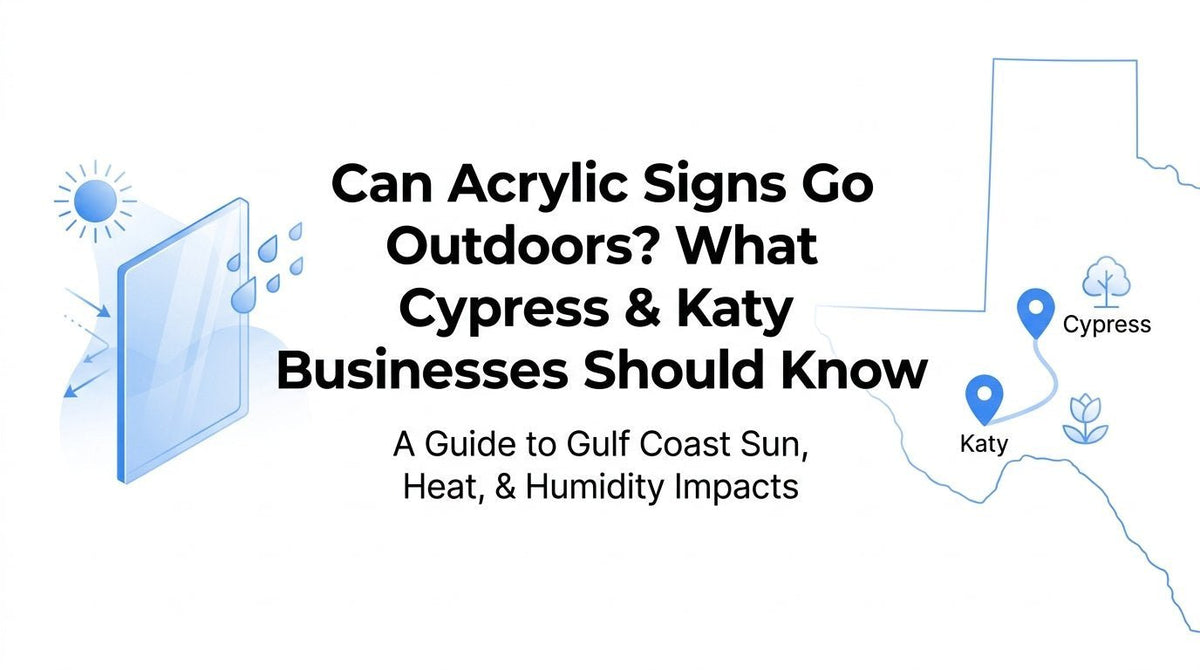
Can Acrylic Signs Go Outdoors? What Cypress & Katy Businesses Should Know
Acrylic signs can go outdoors, but only in covered, protected areas. Full sun and direct weather exposure will shorten an acrylic sign's lifespan and cause visible damage over time, no matter how thick the panel is. If you're weighing acrylic against other materials for a sign in Cypress, Katy, or anywhere along the Gulf Coast, the honest answer (current as of October 2026) depends less on how the sign looks and more on where it's actually going to live.
How Acrylic Reacts to Sun, Heat, and Humidity
Acrylic is a thermoplastic, which means it expands and contracts as temperatures rise and fall. In a Houston summer, a sign mounted on an exterior wall can swing from cool overnight temperatures to surface heat well above 120°F by afternoon. That constant cycling puts stress on mounting points, screws, and standoffs. Over months and years, the repeated expansion and contraction can cause the panel to bow, warp, or pull away from its fasteners, even if it looked perfectly flat the day it was installed.
UV exposure is the second issue. Clear and light-colored acrylic gradually yellows when it sits in direct sunlight for extended periods, and printed graphics on the surface tend to fade faster than they would on a UV-stabilized outdoor substrate. This isn't a defect in the material. Standard cast or extruded acrylic simply isn't formulated the way true outdoor sign substrates are, and the difference becomes obvious after a season or two of full sun.
Humidity adds a third layer of risk that's easy to overlook. Along the Gulf Coast, high moisture in the air combined with seasonal heavy rain means any sign installed outdoors deals with more than just sunlight. If an acrylic panel isn't sealed properly at the edges or around mounting hardware, water can work its way behind the surface or into drilled holes. Over time, that trapped moisture can cause a cloudy or hazy appearance inside the panel that no amount of cleaning will fix. It's a slow, quiet form of damage that often isn't noticed until the sign already looks tired.
None of this means acrylic is a poor material. It's actually one of the best choices for indoor signage precisely because it doesn't have to contend with any of these conditions. The issue is strictly about environment: acrylic performs beautifully where it's shielded from sun, temperature swings, and moisture, and struggles where it isn't.
What "Covered Outdoor" Actually Means
"Covered outdoor" gets used loosely, and that's where a lot of signage decisions go wrong. A genuinely covered location shields the sign from direct sun and rain year-round, not just during certain hours or seasons. Think of a sign mounted under a permanent store awning, inside a breezeway connecting two buildings, or set beneath a covered entryway that extends far enough to block rain at an angle.
Partial shade doesn't meet that bar. An overhang that blocks the sun only in the morning still leaves the sign exposed to hours of direct afternoon light. A shallow awning might keep rain off on a calm day but do nothing against wind-driven rain, which is common during Gulf Coast storms. If sunlight touches the sign face for several hours a day at any point in the year, or if rain can reach it from an angle, it doesn't qualify as fully covered, even though it might feel "outdoor but protected" in casual conversation.
Some real-world examples of locations where acrylic genuinely thrives outdoors:
- Lobby entrance signage positioned under a deep building overhang that blocks sun and rain from every angle
- Directional signs on a covered restaurant or office patio that's enclosed on at least one side
- Breezeway wayfinding signage at a school, medical office, or business park where the sign sits between two structures with a solid roof overhead
In each of these cases, the sign is essentially living in an indoor-like microclimate. It's technically outside, but it's not fighting sun, temperature swings, or rain in any meaningful way. That distinction is what determines whether acrylic is the right call, not whether the sign is physically outdoors at all.
Why Coroplast and PVC Hold Up Better in Full Sun
When a sign has to face real outdoor exposure, coroplast and PVC are built for the job in ways acrylic isn't. Coroplast, the corrugated plastic used for yard signs, real estate signs, and event signage, is designed for exactly this kind of temporary or seasonal outdoor use. Its fluted structure sheds rain, resists cracking under impact, and holds up through the kind of quick-turnaround outdoor placement that political campaigns, open houses, and community events rely on season after season.
PVC, often referred to by the brand name Sintra, is a denser and more rigid material that performs well over a longer outdoor lifespan. Because it doesn't expand and contract the way acrylic does under sustained heat, PVC holds its shape far more reliably when mounted on an exterior wall, fence line, or post in direct sun. That's why it's a common choice for property signs, outdoor directional signage, and multi-season installations that need to look sharp well beyond a single event or one Texas summer.
Both materials are also formulated with better UV resistance for full-exposure use than standard acrylic. That doesn't mean they're immune to fading entirely. All outdoor materials degrade eventually under constant sun. But coroplast and PVC are engineered with that reality in mind, while acrylic is engineered primarily for clarity, polish, and indoor durability. Choosing between them isn't about which material is "better" in the abstract. It's about matching the material's actual design purpose to where the sign will sit.
If you're weighing multiple substrates across different sign locations, our guide on comparing acrylic, PVC, and foam board signs walks through how to match each material to its environment before you order.
For businesses in Cypress, Katy, or Northwest Houston putting up parking lot signage, exterior building signs, or event displays that will sit in the elements for more than a day or two, coroplast or PVC will almost always outperform acrylic and save you a reprint down the line.
Choosing the Right Substrate for Your Sign Location
Before ordering any sign, it helps to answer three straightforward questions about where it's actually going:
- Is the sign under a permanent roofline or overhang? If yes, and that structure blocks sun and rain from every angle, acrylic can work well.
- Will it face direct sun for multiple hours a day at any point in the year? If so, standard acrylic isn't the right choice, regardless of thickness.
- Will it be exposed to wind-driven rain, even occasionally? If there's any chance moisture reaches the sign face or edges, a weather-resistant substrate is the safer call.
For fully indoor applications, acrylic remains one of the strongest choices available. Retail displays, office signage, lobby directories, and menu boards all benefit from acrylic's clarity, clean edges, and polished, upscale appearance. Indoors, none of the stressors that cause warping, yellowing, or clouding come into play, so the material can do what it does best: look sharp for years with minimal upkeep. If that describes your project, our custom acrylic signs collection covers a range of styles suited to interior and covered installations.
For unprotected exterior use, the calculation flips. Parking lot signage, building exteriors, event signage set up outdoors for a full day or weekend, and anything exposed to direct sun or rain should be produced in coroplast or PVC instead. These materials are built to handle exactly those conditions without the warping or fading risk that comes with acrylic in full exposure. It's a more reliable investment for anything that needs to hold up outside for an extended period.
Getting the Right Material the First Time
One of the most useful things we do during the design process at JYS is ask about placement before we ask about aesthetics. A customer might come in wanting acrylic because they've seen it used elsewhere and like the look, but if the sign is going on an exterior wall with no overhead protection, we'll walk through the exposure questions above and recommend a substrate that will actually hold up. That conversation upfront saves customers from paying for a sign twice: once for the version that looks great in the shop, and again for the replacement after a summer in direct sun.
If your project calls for indoor or genuinely covered outdoor signage, our acrylic sign collection is a strong starting point for lobbies, offices, retail spaces, and shaded entryways. If you're outfitting a space that faces real weather, whether that's a parking lot sign, an exterior building sign, or event signage that needs to survive a day outside, our PVC and coroplast collections are built for that kind of exposure and hold up far better across a Gulf Coast season.
Because our team also handles local installation in Cypress and the greater Houston area, we're often able to visit the site and evaluate the sun angle, rain exposure, and mounting conditions in person before production begins. That on-site look at the actual environment, rather than a guess based on a photo or a general description, is often what catches a mismatch between material and location before it becomes an expensive mistake.
Substrate choice ultimately comes down to exposure, not appearance. A sign that looks identical to acrylic on day one can perform completely differently after a few months outdoors depending on whether it's shielded from sun and rain or left to face the Gulf Coast climate directly. Before you place an order, it's worth a quick conversation with our design team about exactly where the sign will be mounted and what it will be exposed to throughout the year. That single step matches you with the right material the first time and avoids a reprint down the road. Experience JYS: Order Now