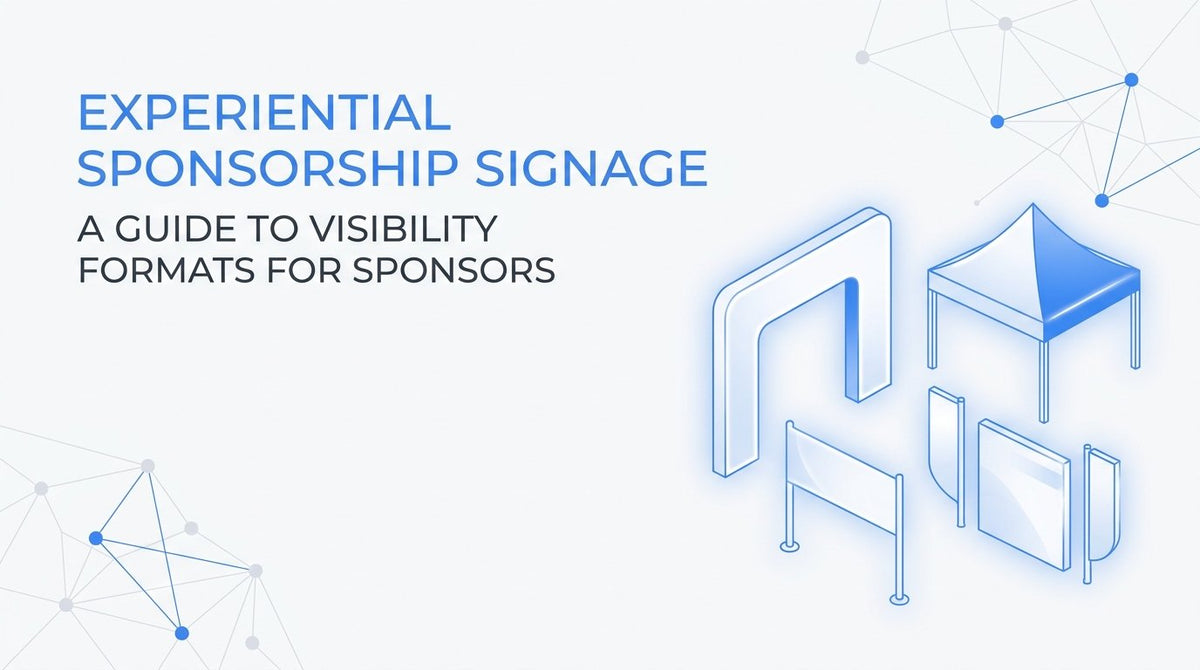
Experiential Sponsorship Signage: A Guide to Visibility Formats for Sponsors
Experiential sponsorship signage is the physical branding, backdrops, tents, arches, floor graphics and banners, that turns a sponsorship line item into visible presence at an event. If you manage sponsorships rather than exhibit at events yourself, your job is different from a booth owner's: you're translating contract language into physical specs, often for spaces you've never walked through. Updated for the 2026 event season, this guide breaks down the main visibility formats sponsors rely on and explains how the deliverables written into your agreement should drive size, placement and material decisions before anyone touches a design file.
How Sponsorship Contracts Drive Signage Specs
Every sponsorship agreement contains language that sounds simple until you try to produce it. "Prominent logo placement," "exclusive category signage," and "visibility throughout the venue" are deliverables, not specs. Someone has to convert those phrases into actual dimensions, materials and locations, and that someone is usually you, working with your print partner, well before the event date.
A few contract clauses deserve close attention because they directly shape production decisions:
- Logo size ratios: Many agreements specify that a sponsor's logo must appear at a set size relative to other sponsors, such as "no smaller than 75% of the title sponsor's mark." That ratio has to be measured on the actual signage, not assumed.
- Exclusivity by zone or category: A clause granting exclusive signage in the "main entrance" or "beverage category" only matters if the physical layout actually isolates that zone from competing brands.
- Minimum visibility duration: Some deals require signage to remain up for a set number of days or hours, which affects material choice. A banner that fades or curls after two days in Texas heat won't satisfy a week-long visibility clause.
- Approval rights on final artwork: If the contract gives either party sign-off before production, build that review cycle into your timeline so it doesn't collide with a shipping deadline.
The most common sponsorship complaint isn't bad artwork, it's a mismatch between what the contract promised and what actually got built. A logo that was supposed to be "prominent" ends up buried at knee height on a shared banner, or an "exclusive" zone turns out to be a shared hallway. The fix is straightforward but often skipped: confirm exact dimensions, sightlines and locations with the venue or event producer before signage goes into production, not after it arrives on-site. Ask for a site diagram or photos of the space, and get committed measurements in writing whenever a clause hinges on size or placement.
Backdrops and Step-and-Repeat Walls for Photo Moments
A step-and-repeat wall is a backdrop printed with a repeating pattern of sponsor logos, designed to be photographed by attendees, media and influencers standing in front of it. It's the default format for red carpets, award stages and media check-in areas because the repetition guarantees your logo appears in the frame no matter where the photographer stands or how the subject is cropped. If your sponsorship deliverable includes "media wall placement" or "photo backdrop presence," this is almost certainly the format in question.
Sizing is where most step-and-repeat orders go wrong. A backdrop that looks fine on a screen can read as an afterthought once it's behind a podium on a wide stage or shot from ten feet back by press photographers. Before finalizing dimensions, find out the stage width, the typical camera distance, and whether the backdrop needs to cover the full width behind a step-and-repeat or just a defined "media moment" zone. Undersized backdrops leave visible gaps of bare wall or curtain in every photo, which defeats the purpose of the placement entirely.
Material choice depends on how the sponsorship travels and how it's viewed. Fabric backdrops pack down small and wrinkle-resist, making them practical for touring sponsorships that move between multiple event dates. Tensioned or rigid backdrop systems, stretched drum-tight over a frame, hold sharper color and a flatter surface, which matters for televised broadcasts or livestreamed events where camera lenses will pick up every wrinkle or seam. If your sponsorship includes a broadcast or livestream deliverable, specify a tensioned system rather than leaving the choice to whoever is producing the piece.
Floor and Wall Graphics for Full-Space Brand Takeovers
Floor and wall graphics let a sponsor's branding extend into spaces that booth-level signage simply can't reach: hallways, entry corridors, escalator landings and lobby floors. For title sponsors with venue-wide agreements, this is often where the "presence throughout the venue" clause actually gets fulfilled, since attendees walk past floor and wall branding whether or not they ever visit a booth or stage area.
Wall graphics and window clings are especially effective for lobby takeovers or the sponsor "zones" that show up in tiered sponsorship packages, where a mid-level sponsor might be guaranteed a defined wall segment near registration or a hallway leading to a keynote room. These formats create a cohesive brand takeover without requiring a large footprint on the show floor itself.
Floor graphics carry a compliance requirement that's easy to overlook until it derails an install: most venues require proof that the material won't damage flooring and won't create a slip hazard. That means slip-resistant laminate finishes and removable, residue-free adhesive are not optional upgrades, they're often a condition of approval. Before you commit to floor branding as a deliverable, confirm the venue's material requirements directly with the facility or event producer, and make sure your print partner can supply documentation if the venue asks for it. Finding out about a restriction after the graphics have shipped is a common way sponsorship deliverables quietly fail on-site.
Branded Tents and Arch Entrances for Outdoor Activations
Outdoor activations, festivals and community events put sponsors in front of attendees before they even reach the main event, and that's exactly the job entry arches and branded tents do. An arch positioned at a festival gate or a race start line puts a sponsor's name at the first point of contact, which is a different kind of visibility than a booth sign someone might walk past. For title sponsors, this front-of-venue placement is frequently the single most visible deliverable in the entire package.
Branded tents work the same way at a smaller scale, anchoring a sponsor's activation zone within a larger outdoor footprint. Branding can cover the canopy, the walls, or both, and the choice usually comes down to how far away attendees will be able to see the tent. A canopy print reads from a distance across an open field; wall branding matters more for attendees walking directly past or through the space. Full coverage, canopy and walls together, is common for title-level deliverables because it maximizes visibility in every direction and in event photography.
These are also the formats most likely to be underestimated during planning. A tent or arch that looks appropriately sized in a design mockup can feel small once it's standing in an open parking lot or festival field, competing with crowds, other vendors and long sightlines. If your contract promises "prominent" or "highly visible" outdoor branding, size the structure for the actual site, not for a desk-side rendering.
JYS builds custom event tents, arches and other dimensional structures specifically for this kind of outdoor sponsorship visibility. If you're mapping a title-sponsor deliverable to a physical structure, JYS's custom 3D brand activations collection is a practical starting point for arches, structural branding and tent builds sized for real event conditions.
Banners and Tiered Visibility: Matching Format to Sponsorship Level
Most multi-tier sponsorship programs scale the physical format to the dollar amount, and understanding that scale helps you plan production in advance rather than scrambling once contracts are signed. Title sponsors typically get the highest-visibility formats: arches, branded tents and dedicated backdrop space. Mid-tier sponsors commonly receive banner placement at defined locations around the venue. Entry-level sponsors are often grouped together on shared signage, such as a co-branded banner or a logo block on a step-and-repeat wall.
For mid-tier sponsors working with a more modest footprint, retractable banners paired with a shared step-and-repeat placement deliver a defined, photographable presence without the cost of a full activation. A retractable banner is easy to ship, quick to set up, and gives a sponsor a consistent visual anchor even in a smaller allotted space, which matters when the contract guarantees a location but not a large one.
Conference and trade-show-based sponsorships add another layer: sponsors in this setting often need visibility both on the show floor and in a separate event or stage area. Pairing banner signage with a proper tradeshow display keeps the sponsor's presentation consistent across the floor, while a dedicated placement on JYS's event backdrops collection covers the photo-moment or stage-area deliverable separately. Treating these as two distinct production needs, rather than trying to stretch one banner across both roles, is usually what keeps a tiered sponsorship deliverable looking intentional instead of improvised.
Whatever tier you're producing for, match the format to what the contract actually promises. A banner can't substitute for an arch if the deliverable calls for "primary entrance visibility," and an entry-level sponsor doesn't need a branded tent. Right-sizing the format to the tier keeps costs predictable and keeps every sponsor's experience matching what they paid for.
Sizing Your Next Activation to the Deliverable
The right sponsorship signage format isn't a creative choice, it's the physical answer to a contract question: what did you promise, and where in the venue does it need to show up. Once you've confirmed dimensions, exclusivity zones and material restrictions with the venue, the format selection, backdrop, tent, arch, floor graphic or banner, follows naturally from the deliverable itself.
What matters most after that is working with a production partner who can size, produce and ship the signage on a timeline that matches your event date, especially when a title-sponsor structure or a broadcast-ready backdrop needs lead time for fabrication. JYS works with sponsorship and brand activation teams on everything from arches and branded tents to backdrops, floor graphics and tiered banner programs, with nationwide shipping and local installation support for events in the Cypress, Katy, Tomball and Northwest Houston area.
If you're planning your next sponsorship activation, start by browsing JYS's custom 3D brand activations collection to see the structural and dimensional formats available for outdoor and large-venue visibility. Experience JYS: Order Now