Custom Event Tent Sizes: A Complete Guide to Choosing the Right Fit
Choosing the wrong tent size is one of the most common, and costly, mistakes event planners make. It usually comes down to guessing instead of calculating actual space needs, whether that's a wedding tent that leaves guests elbow to elbow or a trade show canopy that swallows half your booth allotment. This guide breaks down standard custom event tent sizes, how to measure for your specific event, and what to consider about your site and local rules before you place an order.
Standard Custom Event Tent Sizes and What They're Used For
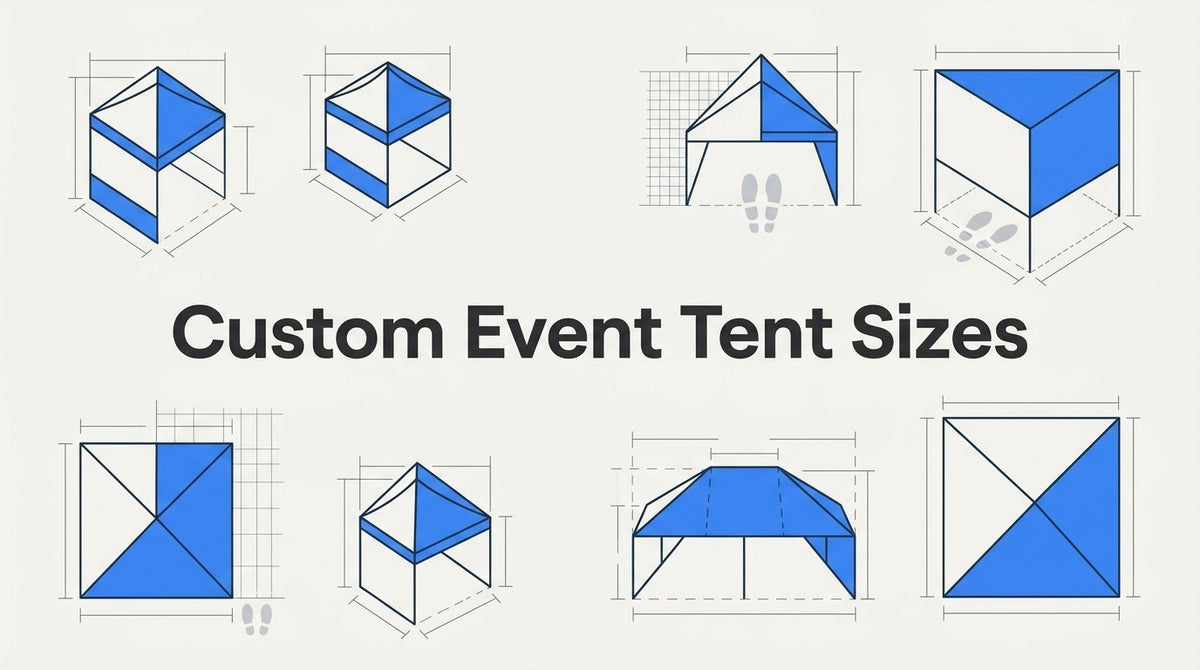
Most event tents are built around a handful of standard footprints, and knowing what each one comfortably handles saves you from ordering by guesswork. A 10x10 tent (100 square feet) works well for a single vendor booth, a small backyard gathering, or a product display at a farmers market. A 10x20 (200 square feet) doubles that space, enough for a modest reception area, a food truck staging zone, or a trade show booth with room for a table and a few staff members to move around.
Step up to a 20x20 (400 square feet) and you have enough room for a small wedding ceremony, a company picnic for 30 to 40 guests, or a compact market pavilion with multiple vendors. A 20x40 (800 square feet) is a popular choice for weddings and community festivals, typically seating 60 to 80 guests with tables, or accommodating a larger standing crowd with room for a bar and a DJ setup. Beyond that, frame and pole tents scale up in 20-foot increments (20x60, 20x80, 20x100 and beyond) for large weddings, festivals, and corporate events with hundreds of attendees.
It helps to understand the difference between tent types before you pick a size. Pop-up canopy tents are lightweight, quick to assemble, and designed for trade shows, markets, and short-duration outdoor booths. They're the standard choice for anyone renting a 10x10 or 10x20 booth space at a fair or convention. Frame tents and pole tents, by contrast, are built for larger footprints and longer setups. Frame tents use a rigid metal structure with no center poles, which keeps the interior open for tables, staging, or dance floors. Pole tents use center and perimeter poles with tensioned fabric, creating that classic peaked look often seen at weddings, but the poles do interrupt floor space.
Standard sizes cover most needs, but not every venue is a clean rectangle. Corner lots, narrow sidewalks, courtyards, and irregular parking areas often call for custom dimensions. If you're working with an unusual footprint, custom-sized canopies and sidewalls can be built to match, so you're not forcing a standard size into a space that doesn't fit it.
How to Calculate the Tent Size You Actually Need
Rather than picking a size off a chart, start with your guest count and the type of event you're running. A commonly used planning rule of thumb is 8 to 10 square feet per seated guest, which accounts for a chair, table share, and walking room. For a standing cocktail reception, plan on roughly 6 square feet per guest, since people take up less footprint without a fixed seat. These are general industry heuristics, not hard rules, but they give you a solid starting point before you round up to a standard tent size.
For example, if you're hosting 80 seated guests at 9 square feet each, you're looking at roughly 720 square feet of usable space, which points you toward a 20x40 tent rather than a 20x20. If those same 80 guests are attending a standing networking event, your footprint drops closer to 480 square feet, and a 20x30 or adjusted custom size might suffice.
Guest count is only part of the equation. You also need to account for everything else going under the tent: a stage or riser, a dance floor, a DJ booth, catering and buffet tables, a bar setup, gift or registration tables, or product displays if you're running a trade show booth. Each of these eats into your usable footprint and should be added on top of your per-guest calculation, not squeezed in afterward. A 12x12 dance floor, for instance, adds 144 square feet that needs to come from somewhere beyond your seating math.
Once you've totaled guest space and furniture or feature space, add a buffer. Walkways between tables, entry and exit flaps, and the perimeter needed for guy lines or staking hardware all require room outside the tent's footprint itself. A good practice is to add several feet of clearance around the entire tent perimeter in addition to the tent's listed dimensions, so the structure itself, not just the covered area, fits comfortably within your venue boundaries.
Trade Show and Market Booth Tent Sizes
If you're exhibiting at a trade show, fair, or outdoor market, your tent size is often dictated before you even start planning: most events assign booth spaces in 10x10 or 10x20 increments. These dimensions have become the standard because they scale efficiently across large event floors and fit most vendor needs without wasting aisle space. A 10x10 canopy typically works for a single-representative booth with a table and signage, while a 10x20 gives you room for a wider display, seating for conversations, or a small product demonstration area.
Because these spaces are tightly defined, accuracy matters more here than almost anywhere else. A canopy that runs even a few inches over the assigned footprint can create problems with neighboring exhibitors or event organizers. This is also where branded graphics come into play. Custom canopy tops, valances, and sidewalls printed with your logo and colors turn a plain tent into a recognizable brand presence from across the venue floor, but the artwork has to be sized precisely to the tent's actual dimensions to avoid stretching, cropping, or awkward seams.
Sidewalls deserve particular attention for booth setups. Full sidewalls can enclose your space for product security or climate control, but they also reduce your open, walk-up footprint, which matters if your booth relies on foot traffic and visibility. Half-walls or no walls at all tend to work better for booths designed to pull people in.
Within a compact 10x10 or 10x20 space, every additional display piece needs to earn its spot. Pairing your tent with a retractable banner stand or a tabletop display lets you add messaging and visual height without consuming the limited floor space a larger structure would need. This combination, a properly sized canopy plus vertical signage, is one of the most efficient ways to maximize impact within a fixed booth footprint.
Common Sizing Mistakes to Avoid
The most frequent sizing error is measuring only the tent's canopy footprint and ignoring what happens at ground level. Pole tents need guy lines that extend well beyond the tent's edges, sometimes six to eight feet or more depending on tent height and wind rating. Frame tents require stakes or ballast anchors around the perimeter as well. If you measure your available space as exactly the tent's listed dimensions, you may find there's no room left for the anchoring system, which is not something you can skip for safety reasons.
Weather contingency space is another blind spot. Many organizers size a tent for a clear, calm day and don't plan for what happens if wind or rain rolls in. Adding sidewalls for weather protection reduces airflow and can make a tent feel more cramped than it did during planning, especially if tables and chairs were already placed at capacity. It's worth sizing up slightly, or planning where sidewalls will attach, so a weather adjustment doesn't force you to cut your guest list or furniture at the last minute.
The third common mistake is ordering a size before checking what your venue or municipality actually allows. Height restrictions, setback requirements from property lines or structures, and ground-type limitations can all affect what size and style of tent you're permitted to install. Some venues also cap the maximum footprint allowed on their property regardless of your guest count, which can force a redesign of your layout, a different tent shape, or even a request for special permission. Confirming these details before you finalize your order avoids a scramble close to your event date.
Ground Surface and Site Considerations That Affect Sizing
The surface your tent sits on affects more than installation method, it can change how much usable space you actually get. On grass or soil, tents are typically staked directly into the ground, and those stakes need clear space around the tent's perimeter. On pavement, concrete, or other hard surfaces, staking isn't an option, so tents rely on water barrels, concrete blocks, or other ballast weights instead. Ballast systems generally take up more room than stakes and are heavier to position, which means your buffer zone around the tent may need to be larger on a hard surface than on turf.
Uneven terrain adds another layer of complexity. A sloped lawn, a site with drainage dips, or a yard with tree roots can make a large single-span tent impractical. In these cases, a different tent style, multiple smaller tents instead of one large structure, or a size adjustment to fit a flatter portion of the site may be the better call. It's worth walking your venue in person, or reviewing detailed site photos, before locking in a size.
Local permitting is the piece most often overlooked until it's too late. Cities and municipalities across the greater Houston area, including Cypress, Katy, and Tomball, may have their own rules governing tent size, required setback distances from property lines or structures, and whether a permit is needed at all based on square footage or intended use. These regulations vary by jurisdiction and change over time, so the right move is always to confirm current requirements with your local permitting office as of your event date, rather than assuming last year's rules still apply.
Working With a Print and Signage Partner on Custom Tent Sizing
Getting tent sizing right is easier with someone who has measured hundreds of venues and can spot problems before they become last-minute headaches. At JYS Sign & Print Co., we walk customers through their guest count, venue layout, and site conditions to recommend a tent size that actually fits, whether that's a standard 10x20 for a market booth or a custom footprint for an oddly shaped courtyard. Because we handle both the tent and the branded materials that go with it, we can flag sizing issues that a tent-only vendor might miss, like graphics that won't scale cleanly to a custom dimension.
A tent is rarely the only piece of a branded event setup. We pair custom event tents with matching backdrops, retractable banners, floor graphics, and window or vehicle graphics so your entire footprint, not just the canopy overhead, reflects your brand consistently. For a trade show exhibitor, that might mean a 10x10 canopy with a coordinated tabletop display and banner stand. For a company hosting a customer appreciation event, it might mean a 20x40 frame tent alongside a printed step-and-repeat backdrop for photos.
Where you're located also shapes how we support your order. For customers in Cypress, Katy, Tomball, and the broader Northwest Houston area, we offer local installation services, so our team handles setup, staking or ballast placement, and teardown on-site. For customers ordering from further out, we ship custom tents and graphics nationwide with clear setup instructions for self-installation. Either way, the goal is the same: a tent sized correctly the first time, with graphics that fit it precisely.
Get Your Measurements Right Before You Order
Before you request a quote, take two numbers to the table: your expected guest count and the actual dimensions of your venue space, including any slope, obstructions, or hard surfaces. Those two figures, more than any standard size chart, determine what will actually work on the day of your event. From there, a sizing consultation can help you avoid the common traps of underestimating buffer space, ignoring weather contingencies, or skipping a permit check.
Our team at JYS Sign & Print Co. is ready to help you measure, choose, and customize the right tent for your event, along with any branded graphics that go with it. Experience JYS: Order Now