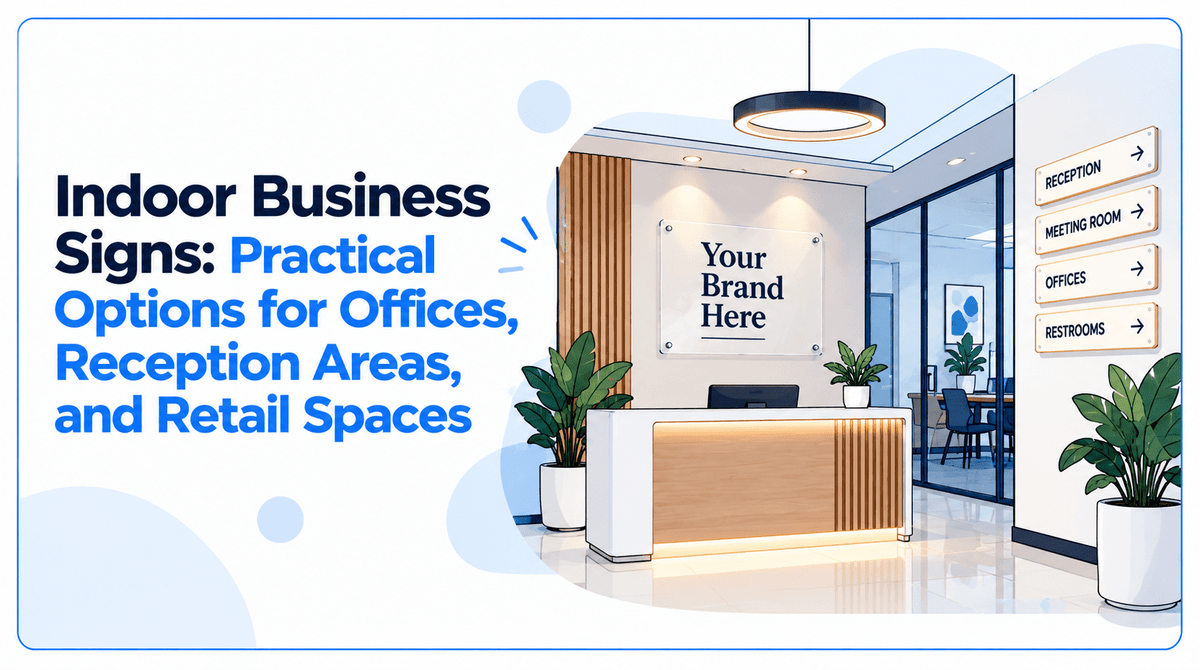
Indoor Business Signs: Practical Options for Offices, Reception Areas, and Retail Spaces
Indoor business signs do more than fill an empty wall. They help visitors recognize your brand, understand where to go, and find the information they need inside your space.
The right sign depends on where it will be displayed and what it needs to communicate. A company logo behind a reception desk has a different job from a directional sign in an office or a promotional graphic inside a retail store.
If you're planning indoor signage, start with the purpose of each sign. Then choose a format that suits the space, the message, and how you expect to use it.
Start With the Purpose of the Sign
Before choosing a material or design, identify what the sign needs to accomplish.
Most indoor business signage falls into a few practical categories.
- Brand identification: Displaying your company name or logo in a lobby, reception area, or office.
- Visitor communication: Welcoming guests or communicating information they need when they arrive.
- Navigation: Helping people identify rooms, departments, or destinations.
- Retail messaging: Communicating services, promotions, product information, or other customer-facing messages.
- Interior branding: Carrying your brand identity into the space beyond the storefront.
You may need more than one type of sign. A reception logo, room-identification signs, and retail promotional graphics can serve different purposes while sharing a consistent visual direction.
Start with the message and placement. The material and format should follow from those decisions.
Indoor Sign Options for Offices and Reception Areas
Office and reception signage often needs to identify the business clearly while fitting the space where visitors first encounter the brand.
Acrylic Logo Signs

An acrylic logo sign can be an option for businesses planning a branded reception wall or office interior.
When choosing a lobby sign, consider the wall's available space, the size and proportions of your logo, and how the sign will look from the entrance and visitor seating areas.
Think about the complete composition rather than the sign alone. A logo that is too small for its wall may be difficult to notice, while a design that competes with surrounding architectural details can make the reception area feel crowded.
JYS has a dedicated guide to Acrylic Logo Signs for Office Lobbies, which covers the specific considerations involved in selecting a lobby logo sign.
Interior Brand Displays

Some businesses want their brand to be visible beyond the reception desk. A branded wall or interior display can help maintain a consistent visual identity in meeting areas, customer-facing spaces, or other parts of the workplace.
Before planning an interior brand display, decide whether the main goal is to present the company logo, communicate a message, or create a larger graphic feature.
The answer affects the amount of artwork required, the dimensions of the display, and the format you should investigate.
Informational and Directional Signs

Visitors may also need clear information about rooms, departments, or where to go next.
For these signs, clarity takes priority over decoration. Use concise wording, a logical layout, and text that is appropriate for the distance from which people will read it.
If the sign communicates essential directions or room identification, make sure its placement is easy to understand within the actual building layout.
Indoor Sign Options for Retail Spaces
Retail signage has a different set of priorities. Customers may need to identify the business, understand what it offers, find a particular area, or notice a promotion.
Window Graphics

Window graphics can communicate branding, services, hours, or promotional messages on glass.
The right design depends on the purpose of the graphic and how it will appear from the intended viewing side. Before ordering, consider the window dimensions, the information you need to display, and whether the message will remain in place or change regularly.
JYS provides more detailed guidance in its article on How to Choose and Install Window Graphics for Your Business.
Window graphics are not interchangeable with every other type of interior sign. Confirm the appropriate product, material, and installation requirements for the glass and intended application.
Promotional and Informational Displays

Retail businesses may also need signs to communicate services, highlight promotions, or provide information within the store.
For a message that changes frequently, consider how easily the sign can be updated or replaced. For a more permanent message, prioritize a format and design that suit the location and expected use.
Avoid trying to communicate everything on one sign. A clear headline and a focused message are usually easier for customers to process than a crowded layout filled with competing details.
JYS offers several printed sign and display formats. The appropriate choice depends on the project requirements, so confirm availability, material, dimensions, and intended use before placing an order.
Choose the Format Based on Location and Use
Two signs can communicate the same message but require different formats because they will be displayed in different environments.
Use these questions to narrow your options.
How permanent is the message?
A company logo intended to remain in place for an extended period should be planned differently from a promotion that changes each month.
Think about how frequently the content will need to be replaced before selecting the sign format.
How will people view the sign?
Consider the distance from which visitors or customers will read it, the available lighting, and the amount of visual competition around the sign.
A sign positioned behind a reception desk has different viewing conditions from a graphic placed on a retail window or near a checkout area.
How much space is available?
Measure the intended display area before deciding on the dimensions. Consider nearby furniture, doors, windows, shelving, and other visual elements.
For signs that need to fit a specific wall, window, or display area, use accurate measurements rather than estimating from a photograph.
What material and production method suit the project?
Material choice should follow the sign's intended application, appearance, and production requirements.
Acrylic, PVC, foam board, vinyl graphics, and other formats are not interchangeable in every situation. Their suitability depends on the specific product and how it will be used.
For a closer comparison of three common rigid sign materials, read JYS's guide to Acrylic vs. PVC vs. Foam Board Signs.
If you are considering an option that requires mounting, custom fabrication, or installation, confirm what is included in the order. JYS's standard terms state that installation is not included unless it is specifically included in the written quote or invoice.
Keep Your Indoor Signage Consistent
A business may use several signs throughout its office or retail space. They do not all need to have the same dimensions or layout, but they should support a recognizable visual identity.
Consistency can come from a few deliberate choices:
- Use approved brand colors consistently where appropriate.
- Keep typography compatible across related signs.
- Use a clear visual hierarchy for headings and supporting information.
- Avoid adding decorative details that compete with the message.
- Give each sign a specific purpose within the space.
For example, a reception logo can focus on brand identification while a retail promotional sign emphasizes an offer. They can have different layouts while still using compatible brand elements.
The objective is a space that feels considered and easy to navigate, not a collection of signs that all look exactly alike.
What to Confirm Before Ordering Indoor Business Signs
Once you have identified the sign types you need, prepare the details for each order.
Confirm the dimensions and location
Measure the intended display area and verify the finished sign dimensions. For window graphics, confirm the relevant glass measurements. For wall signs, consider the available wall space and the surrounding layout.
Prepare the artwork
Use the highest-quality original logo or artwork available. Confirm the file requirements for the specific product before submitting the design.
If the sign uses exact brand colors, tell JYS before production. Color matching or additional proofing may require additional cost or time.
Finalize the content
Check business names, room labels, service descriptions, promotional wording, contact details, and any other information that will appear on the sign.
If the sign includes a time-sensitive promotion, verify that the content and dates are correct before approving production.
Confirm production and installation responsibilities
Review the product specifications, quantity, quote, production timeline, and any installation requirements before placing the order.
JYS's Proof, Artwork & Color Policy explains the customer responsibilities involved in submitting artwork and approving a proof. Review the proof carefully, since approval authorizes production of the design as shown.
Explore Indoor Business Sign Options With JYS
The best indoor business sign is the one that fits the space, communicates the right information, and supports the way your business operates.
Start by identifying what you need each sign to do. Then compare the available formats, confirm the dimensions and artwork requirements, and plan how the signs will work together throughout your office, reception area, or retail space.
Explore JYS Sign & Print Co. to review available sign and graphic options. You can also use the related guides above to compare materials, plan office lobby signage, and prepare window graphics.
A clear purpose and accurate project details make it easier to choose signage that fits your business—not just a sign that looks good on its own.