Contour Cut Foam Board Signs: What They Are and When to Use Them
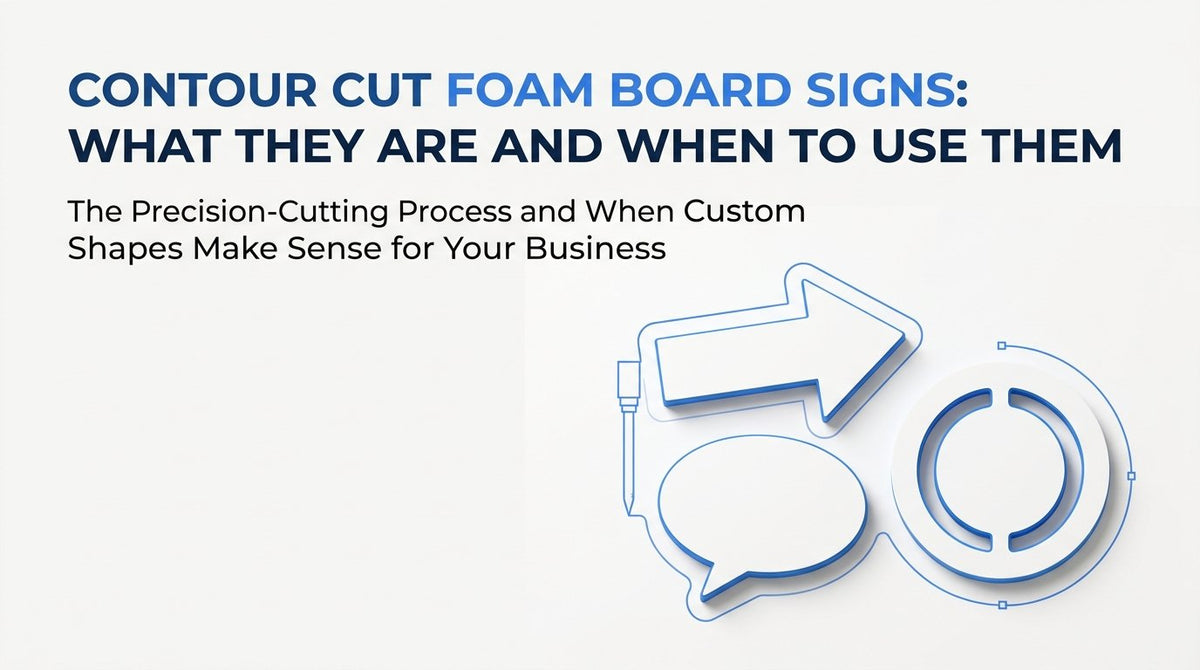
Updated October 2026. Contour cut foam board signs are custom signs cut precisely along the outline of a shape, logo, or character instead of a standard rectangle, which gives displays a polished, dimensional look. The printed graphic doesn't sit inside a boxy border. The sign itself becomes the shape, whether that's a mascot, a product silhouette, or a company logo. This article explains how contour cutting works, when it's worth the investment, and what to expect when you order one from JYS Sign & Print Co.
How Contour Cutting Differs From Standard Foam Board Printing
Standard foam board signs are printed and then trimmed into a rectangle or square, regardless of what's printed on them. Contour cutting works differently: a CNC router or laser follows the exact outline of the printed artwork, so the finished sign has no visible border at all. If you print a coffee cup, the final piece is shaped like a coffee cup, not a rectangle with a coffee cup printed inside it.
Foam board itself is a rigid substrate made from a PVC-foam core sandwiched between two smooth printable facing sheets. That construction is part of why it's so well suited to contour cutting. The foam core cuts cleanly without crumbling or chipping the way particleboard or corrugated cardboard might, and the facing sheets keep the printed image crisp right up to the cut edge. The result is a shaped sign with a smooth, finished profile rather than a rough or fuzzy edge.
It's worth clarifying the difference between "contour cut" and "die cut," since customers sometimes use the terms interchangeably when requesting quotes. Contour cutting uses a router or laser guided by a digital file to follow an irregular, often one-off shape, which makes it ideal for custom logos, mascots, or unique artwork produced in small quantities. Die cutting uses a physical die, similar to a cookie cutter, pressed through material to produce the same shape over and over at high volume. Die cutting makes more economic sense for thousands of identical stickers or labels; contour cutting is the better fit for a handful of standees, a single trade show cutout, or a one-time event display. Knowing which term applies to your project helps your print provider quote it accurately and choose the right equipment for the job.
Common Uses for Shaped Foam Board Signs
Retail brands and trade show exhibitors use contour cut foam board to break up the visual monotony of a booth. A cutout mascot standing beside a backdrop, a product silhouette mounted on a table, or a logo shape hung above a display all draw the eye more effectively than another rectangular sign competing for attention in a row of identical booths. Because foam board is lightweight, these shapes are easy to transport, set up, and break down between shows.
Schools and nonprofits rely on shaped foam board for a different kind of impact. Character cutouts for reading programs, mascot standees for pep rallies, and photo-op cutouts at fundraisers all give an event a professional, custom feel without the cost of a permanent structure. Awards ceremonies and graduations often use contour cut nameplates, trophies shapes, or school-crest cutouts as backdrop accents or stage decor.
Real estate professionals and property managers use shaped foam board for directional and promotional signage. Custom arrow shapes guide visitors to an open house, icon-shaped signs mark amenities on a property tour, and silhouette cutouts of a home or building can reinforce a listing's branding. Mounted on yard stakes or freestanding easels, these signs hold up well for the short-term outdoor use most real estate signage requires. Across all these use cases, the common thread is the same: a shaped sign reads as more deliberate and higher-quality than a printed rectangle, which matters when you're trying to make an impression at a booth, an event, or a curb.
Design File Requirements for Clean Cuts
Getting a clean contour cut starts with the artwork file, and this is where most avoidable delays happen. The cut line needs to exist as its own vector path, typically set to a distinct spot color in a program like Adobe Illustrator, and kept separate from the printed artwork layer. That vector path tells the router exactly where the blade or laser travels. A flattened JPG or PNG with no separate cut path leaves the production team guessing at your intended outline, which slows down the proofing process or forces a redesign.
Bleed matters here just as much as it does on standard prints. We recommend at least 1/8-inch of bleed extending past the intended cut line on all sides. If there's any slight registration shift during printing or cutting, that extra margin prevents a thin sliver of white board from showing along the edge, which is one of the most common flaws on amateur contour cut signs.
If you're working from a logo file that isn't vector-based, or a photo you'd like turned into a standee, don't assume it needs to be cut-ready before you reach out. Our design team routinely traces raster logos and photos into clean, cuttable vector paths, and can clean up low-resolution artwork so the final edge looks intentional rather than jagged. It's far easier to fix this at the file stage than after a sign has already been routed, so send us what you have, even a phone photo of a logo on a shirt, and we'll tell you what's needed to get it print- and cut-ready.
Choosing Thickness, Finish, and Mounting Options
Foam board thickness affects both rigidity and cost, and the right choice depends on the sign's size and how it will be handled. 3/16-inch board is the standard choice for smaller shapes, tabletop displays, and signs that won't be moved often; it's light, affordable, and holds its shape well at modest sizes. For larger freestanding cutouts, life-size standees, or anything that will be picked up, carried, or repositioned frequently, 1/2-inch board offers considerably more rigidity and resistance to warping or bowing. Choosing 3/16-inch board for a large, freestanding shape is one of the more common mistakes we see, since thinner board can flex or lean under its own weight once it's cut into an irregular, less structurally supported shape.
Finish is the next decision. A matte laminate reduces glare and gives a more upscale, subdued look, while a gloss laminate makes colors pop and adds a layer of surface protection. For signs that will be touched repeatedly, such as photo-op cutouts or interactive props at a fundraiser, a laminate finish adds real durability against fingerprints, smudges, and minor scuffs over the course of an event.
Mounting depends on how and where the sign will be displayed:
- Yard stakes for outdoor directional signs, property markers, or event signage placed on grass or landscaping
- Easel backs for tabletop standees, retail counter displays, or awards presentations
- Command strips or foam mounting tape for wall-mounted shapes, window displays, or lightweight logo cutouts
Customers in Cypress, Katy, Tomball, and Northwest Houston can also add local installation for larger standees or window displays that need precise placement, which is worth considering for anything oversized or positioned somewhere highly visible.
Indoor vs. Outdoor Durability Considerations
Standard foam board is best suited for indoor use or brief outdoor exposure, such as a single day at a farmers market or a weekend open house. It is not a weatherproof material. Rain will soften and warp the foam core over time, and direct sun can cause the facing sheets to fade or delaminate from the core if the sign is left outside for an extended stretch. If your event runs indoors, or your outdoor display is up for a matter of hours rather than days, standard foam board holds up fine.
For outdoor events that run longer, or signage that needs to survive repeated exposure to sun and moisture, PVC board and coroplast are better substrate choices, and both can be contour cut using the same process. PVC board offers a similar rigid, smooth surface to foam board but resists moisture far better, making it a solid substitute when you like the look of a shaped sign but need it to last through a multi-day outdoor festival or a season of yard display. Coroplast, the corrugated plastic material commonly used for yard signs, is more flexible and budget-friendly, and it's a practical option for contour cut arrows, icons, or directional shapes that need to survive Houston-area heat and humidity for weeks at a time.
Because cutting complex, irregular shapes takes more time on the router than cutting a standard rectangle, contour cut orders generally carry a longer production window than a comparable flat sign. Lead times and current pricing shift with order volume and season, so as of this writing, we recommend confirming turnaround directly with our team before locking in an event date, especially if you're planning around a trade show or graduation with a fixed deadline.
Getting a Contour Cut Sign Made With JYS
Ordering a contour cut foam board sign from JYS Sign & Print Co. is straightforward. Send us your artwork, logo, or even a reference photo, and our team will review it and let you know what's needed to get it print- and cut-ready. We'll produce a proof that shows both the printed artwork and the marked cut line, so you can see exactly how the finished shape will look before anything goes to production.
Once you approve the proof, we move into production and cutting. From there, you can choose local pickup, or we'll ship your finished sign nationwide. If you're based in Cypress, Katy, Tomball, or the greater Northwest Houston area, ask about adding local installation, particularly useful for larger standees, trade show pieces, or window displays where precise placement makes a difference.
A well-executed contour cut sign says more about your brand or event than a standard rectangle ever could, and getting the details right, from board thickness to file setup, is what separates a clean, professional shape from one with rough edges and white slivers along the outline. Our team handles that groundwork every day, whether it's a mascot for a trade show booth, a standee for a school fundraiser, or a directional arrow for a property tour. If you have a shape, logo, or photo in mind, reach out and we'll walk you through thickness, finish, and mounting options suited to your project. Experience JYS: Order Now